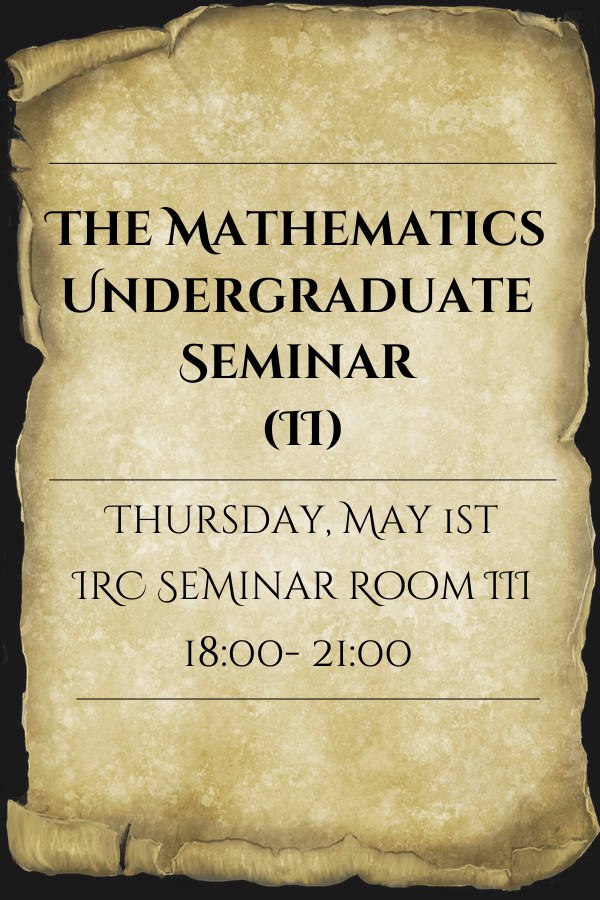
The second session of UGS continued our exploration of mathematics across disciplines, featuring talks on
protein structure determination, coding theory, and legendary mathematical problems.
Speakers & Topics
Loredana-Maria Iacob – Mathematics of Protein Structure Determination18:30—19:05Scientists lacked a clear understanding of how waves interact with atoms and
crystals. Analysing diffraction peaks determines the spacing between atomic planes and, consequently,
the crystal's structure. In this talk, we introduce Bragg's law in the context of X-ray
Crystallography. We outline the protein structure determination by crystallization, Fourier analysis
on diffraction intensities, and finally solving the electron density map. Even in a field where
mathematics is assumably absent, this talk illustrates the power of mathematical construction and its
unforeseen applicability to complex systems and real-world phenomena.
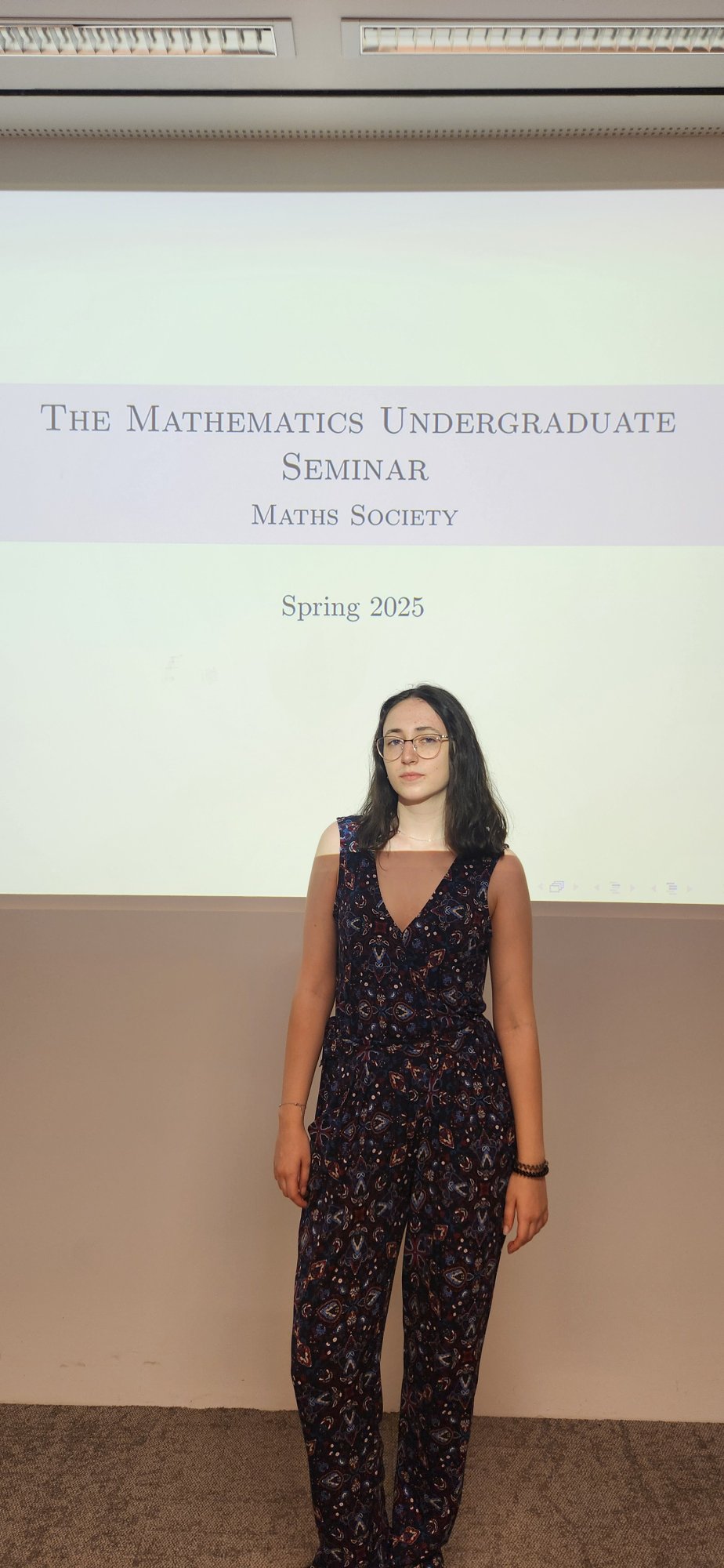
Loredana-Maria Iacob at the Mathematics Undergraduate Seminar
Aly Assaf – On the Problem of Reliable Communication: Shannon's Theorem and Polar
Codes19:30—20:05Coding Theory is responsible for facilitating reliable message-passing over
communication channels. In 1948, Claude Shannon proved that for every channel, there exists a family
of error-correcting codes that allow reliable communication at any rate below the channel's capacity.
This talk introduces the general Coding Theory scheme and outlines Shannon's key arguments. We explore
Erdal Arikan's polar codes, the first constructive example to achieve Shannon's maximum capacity over
symmetric binary-input memoryless channels—a discovery presenting a strong candidate for future 6G
communication.
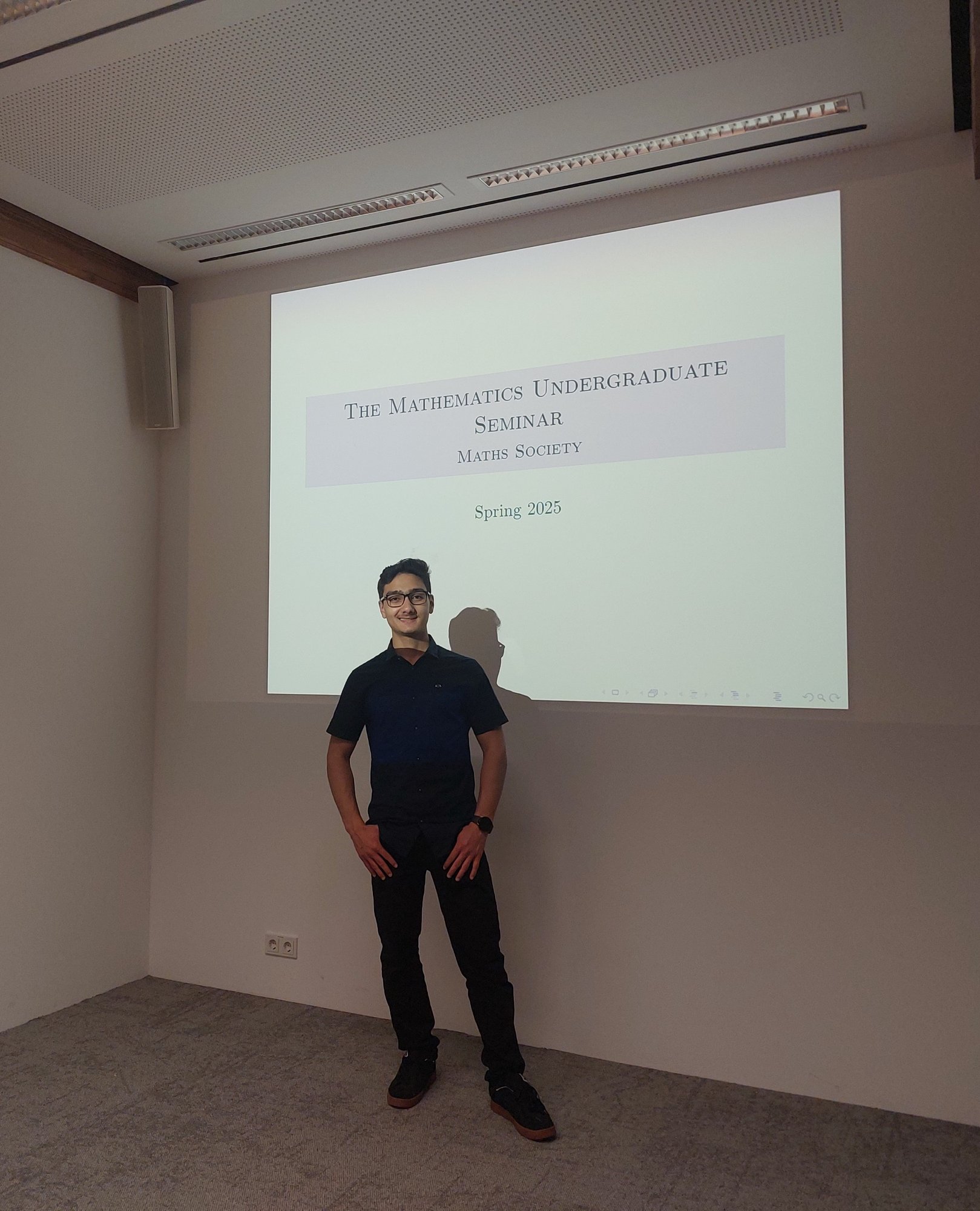
Aly Assaf at the Mathematics Undergraduate Seminar
Vano Kakiashvili – The Legend of Question Six20:10—20:45The Legend of Problem 6 goes back to the 1988 International Mathematics
Olympiad for high school students. The problem is so challenging that four brilliant number theorists
could not solve it in six hours. Behind this problem lies a powerful and elegant technique known as
Vieta Jumping, used to tackle Diophantine equations. Our goal is to explore the underlying ideas of
Vieta Jumping, its strategic use in proofs by contradiction, and its role in unlocking unexpected
symmetries. This talk offers both insight and inspiration for problem-solving.
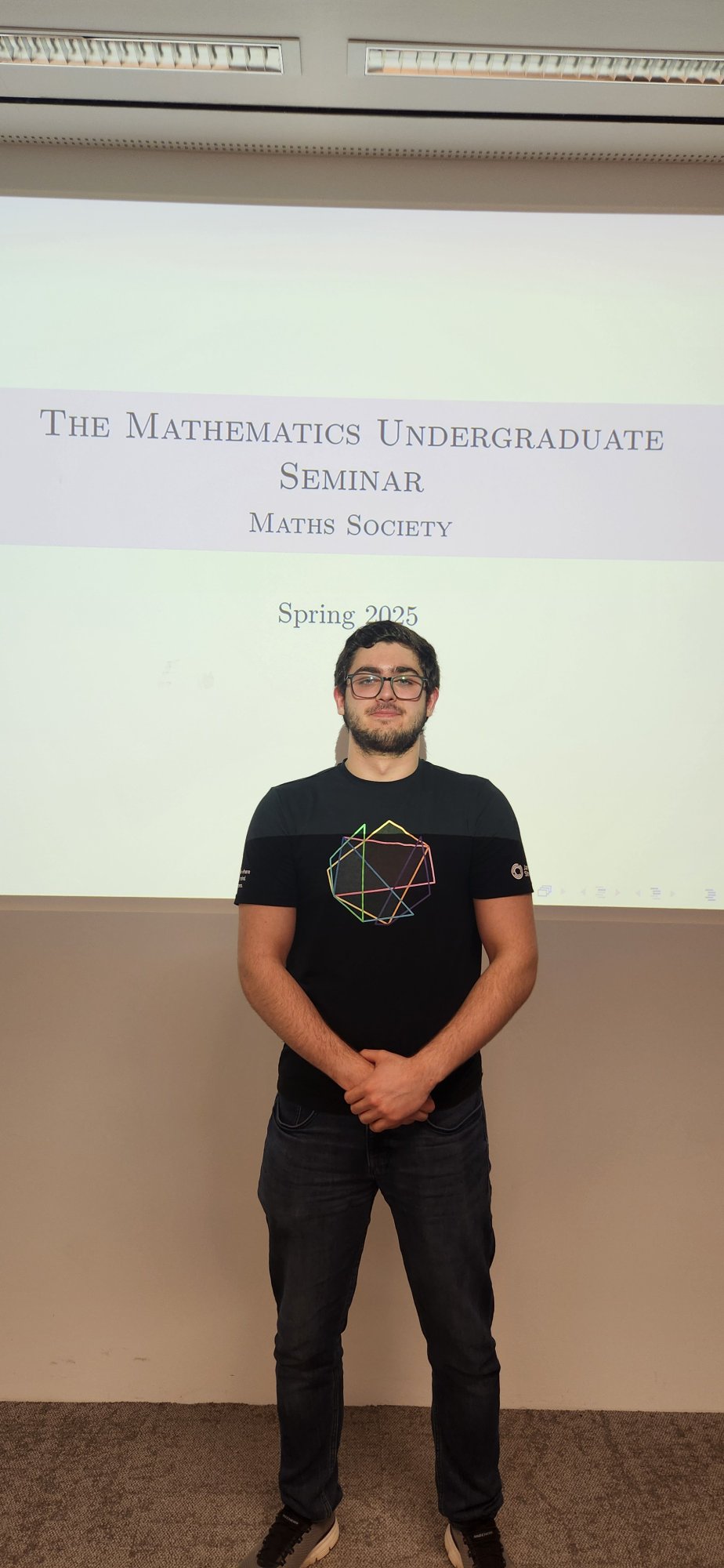
Vano Kakiashvili at the Mathematics Undergraduate Seminar