Would you rather have €100 today or €115 in one year? The answer is mathematics. A joint seminar by the Math Society and IB&CM Society — from the time value of money to Black–Scholes.
Meet the Speakers
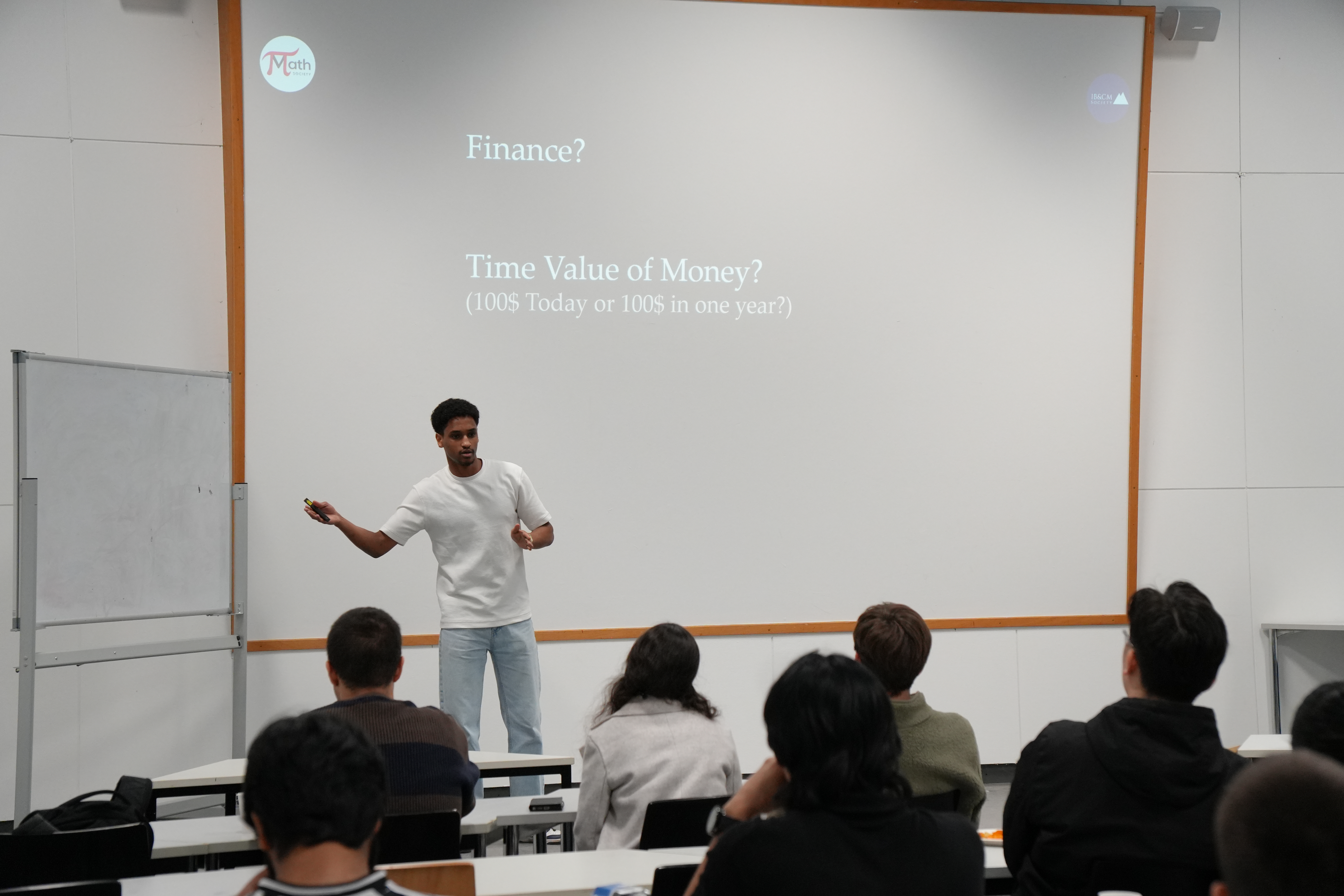
Eyosiyas
Contributed to the seminar with insights into financial applications and helped connect the mathematical theory to real-world trading and market behaviour.
"€100 today or €100 in one year?"
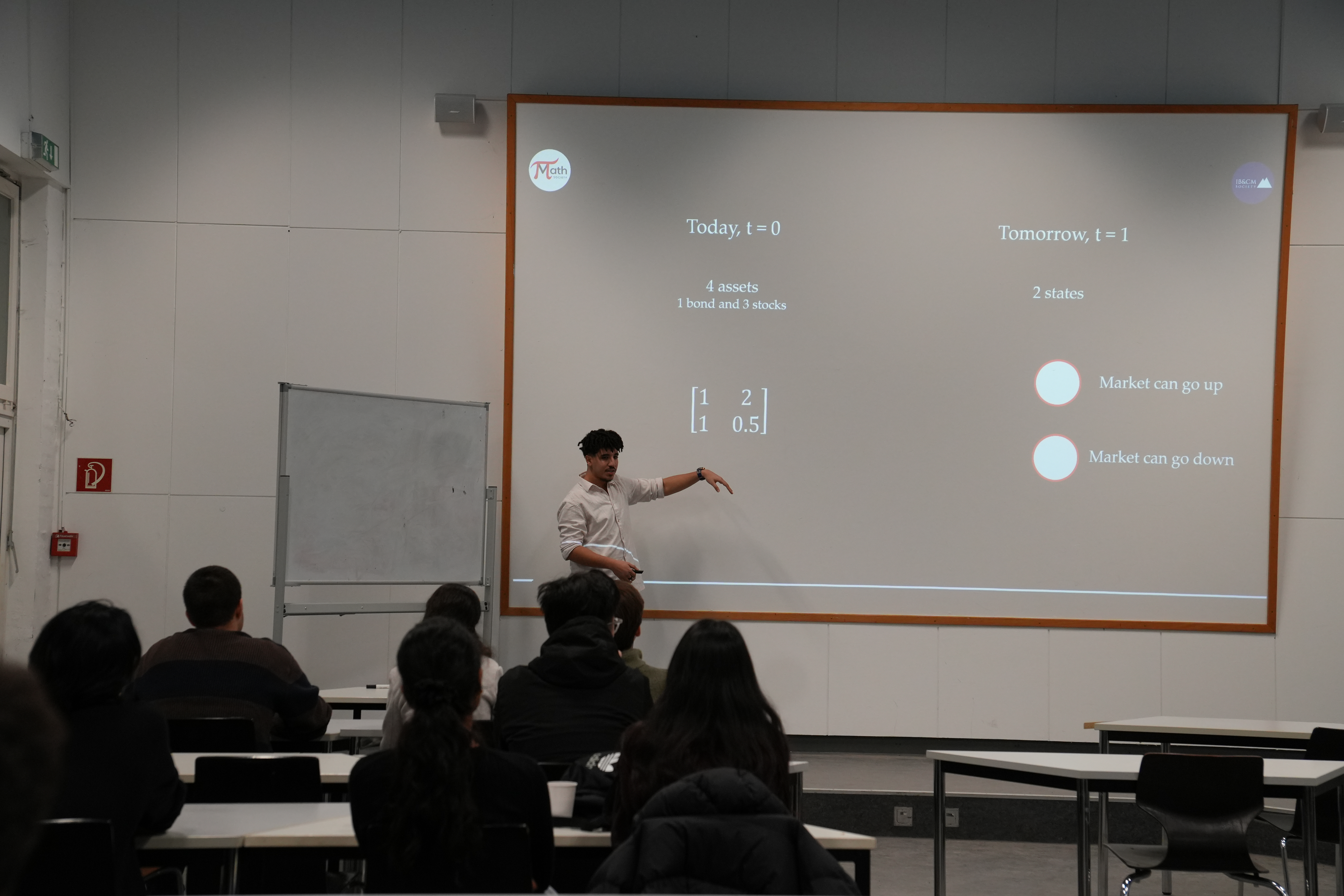
Ahmed
Formalised no-arbitrage theory, derived European call pricing via replicating portfolios and binomial trees, then built up to Brownian motion and the Black–Scholes PDE.
"Buy low, sell high — instantly"
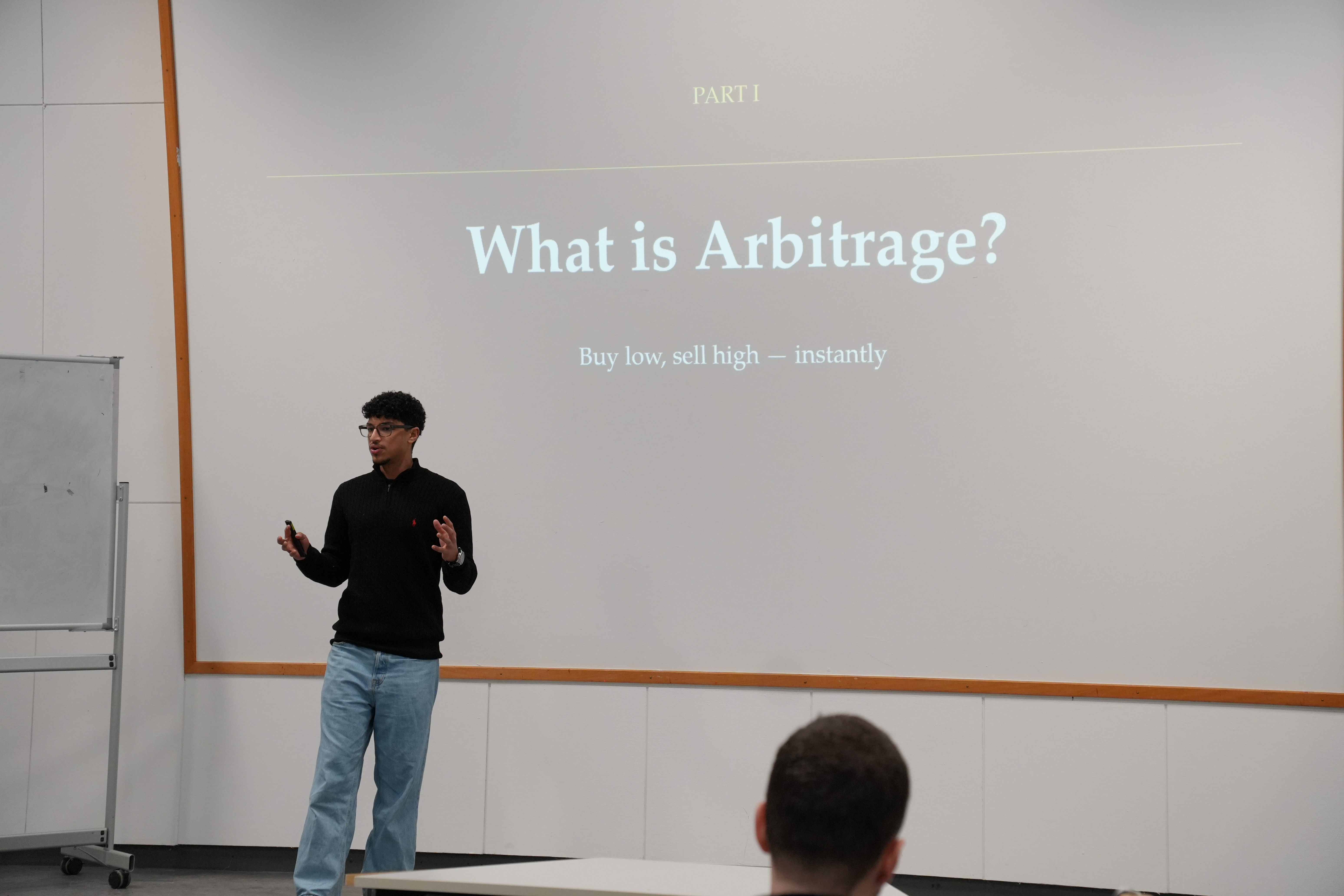
Muhammad
Contextualised it all through quantitative finance — who quants are, where they work, and how HFT strategies exploit market inefficiencies in milliseconds.
"Math → Finance?"
Time Value of Money & Portfolios
A euro today is worth more than a euro tomorrow — inflation erodes purchasing power over time. This gives us present value and future value: tools to compare money across time. If €100 grows to €105 at 5% interest, then the present value of €105 in one year is €100.
Arbitrage & The Law of One Price
Arbitrage exploits price differences for the same asset in different markets for a risk-free profit. Arbitrageurs self-correct free markets, enforcing the law of one price: identical assets must trade at the same price everywhere.
No-Arbitrage Assumption
Formally: a portfolio h is an arbitrage iff its cost today is ≤ 0 while its payoff is ≥ 0 in every state (strictly positive in at least one). The no-arbitrage assumption asserts no such h exists — not because it never appears, but because HFT exploits it so fast it vanishes instantly.
Hedging & Options
Hedging is financial insurance — holding an asset that rises when your main investment falls. Options are the primary tool: you pay a premium upfront for the right (not obligation) to buy or sell at a fixed price.
📞 Call Option
Right to buy at strike price K. Valuable when you expect the price to rise.
📤 Put Option
Right to sell at strike price K. Valuable when you expect the price to fall.
💎 Strike Price (K)
The fixed price at which the holder may buy or sell.
🏷️ Premium
The upfront cost of the option — paid regardless of whether it's exercised.
Pricing Options: The Binomial Tree
To price a European call, we find a replicating portfolio of Δ shares and B bonds matching the option's payoff in each outcome. By the law of one price, the option must cost exactly Δ·S + B today. This simplifies to a risk-neutral probability q = (y − d) / (u − d):
q is not the real probability of the market going up — it's a synthetic measure under which the expected stock payoff equals its price today. Extending to multiple periods (the binomial tree) gives the general closed form:
Quantitative Finance & The World of Quants
Quants are the mathematicians at the heart of modern finance. They work across three types of institutions:
Hedge Funds & Trading Firms (e.g. Renaissance Technologies): build proprietary models to generate returns.
Asset Managers (e.g. pension funds): manage large portfolios and control risk.
Their work: price instruments, manage risk, and build trading strategies — automated programs that exploit statistical patterns across millions of trades per day, often in under a second.
Brownian Motion & Black–Scholes
Real markets move continuously, not in discrete steps. Stock prices follow geometric Brownian motion — always positive, driven by a random Wiener process W(t):
Because dW² = dt (variance grows linearly in time), the classical chain rule breaks. Itô's lemma corrects this with an extra term:
Applying Itô's lemma to C(S,t), constructing a delta-hedged replicating portfolio, and invoking no-arbitrage yields the Black–Scholes PDE:
Solving with boundary condition C(S,T) = max(S − K, 0) gives the Black–Scholes formula — the mathematical engine behind the multi-trillion dollar derivatives market.
- €1 today > €1 tomorrow — always invest, never just save.
- Arbitrage enforces the law of one price across all free markets.
- Options give unlimited upside with capped downside.
- Risk-neutral pricing: discount the expected payoff under a synthetic probability measure.
- Stock prices follow geometric Brownian motion — always positive and continuous.
- Because dW² = dt, classical calculus fails; Itô's lemma provides the fix.
- Black–Scholes PDE: the equation whose solution prices any European option.
Finance looks like intuition. Underneath, it is mathematics — all the way down to the partial differential equation.