Could we imagine the huge impact that one tiny thought could have made?
This was the fourth episode of "The Math Behind..." series, where Math Society dove into the Butterfly Effect and Chaos Theory of Mathematics. Led by Dr. Ivan Ovsyannikov, ...where he explored how tiny initial changes in complex systems can lead to vast, unpredictable outcomes, fundamentally altering our understanding of deterministic patterns.
A Deep Dive into the world of confusion
Watch how Dr. Ivan Ovsyannikov unravels the mathematics behind one of the most visually stunning films ever made, from Dynamic Systems to the mysteries of the Lorenz Attractors for Robust Chaos:
Math Society Event: Butterfly Effect and Chaos Theory
How and when do we expect things to happen in the real world?
And that is a complex subject! Imagine driving a car: as a driver, you are laser-focused on the road, knowing that even a tiny miscalculation in speed can cause significant problems. But the real Chaos Theory starts when our "almost" affects everyone else. Just like a discriminant flipping a system from stable to unstable, a single driver tapping their brakes for a split second can trigger a massive, unpredictable traffic jam miles behind them. This is the Butterfly Effect in action—where tiny nudges on a parabola of factors refuse to stay small, settling instead into the strange attractors of real-world gridlock. It proves that in a deeply connected system, "almost" is a luxury the math simply doesn't forgive.
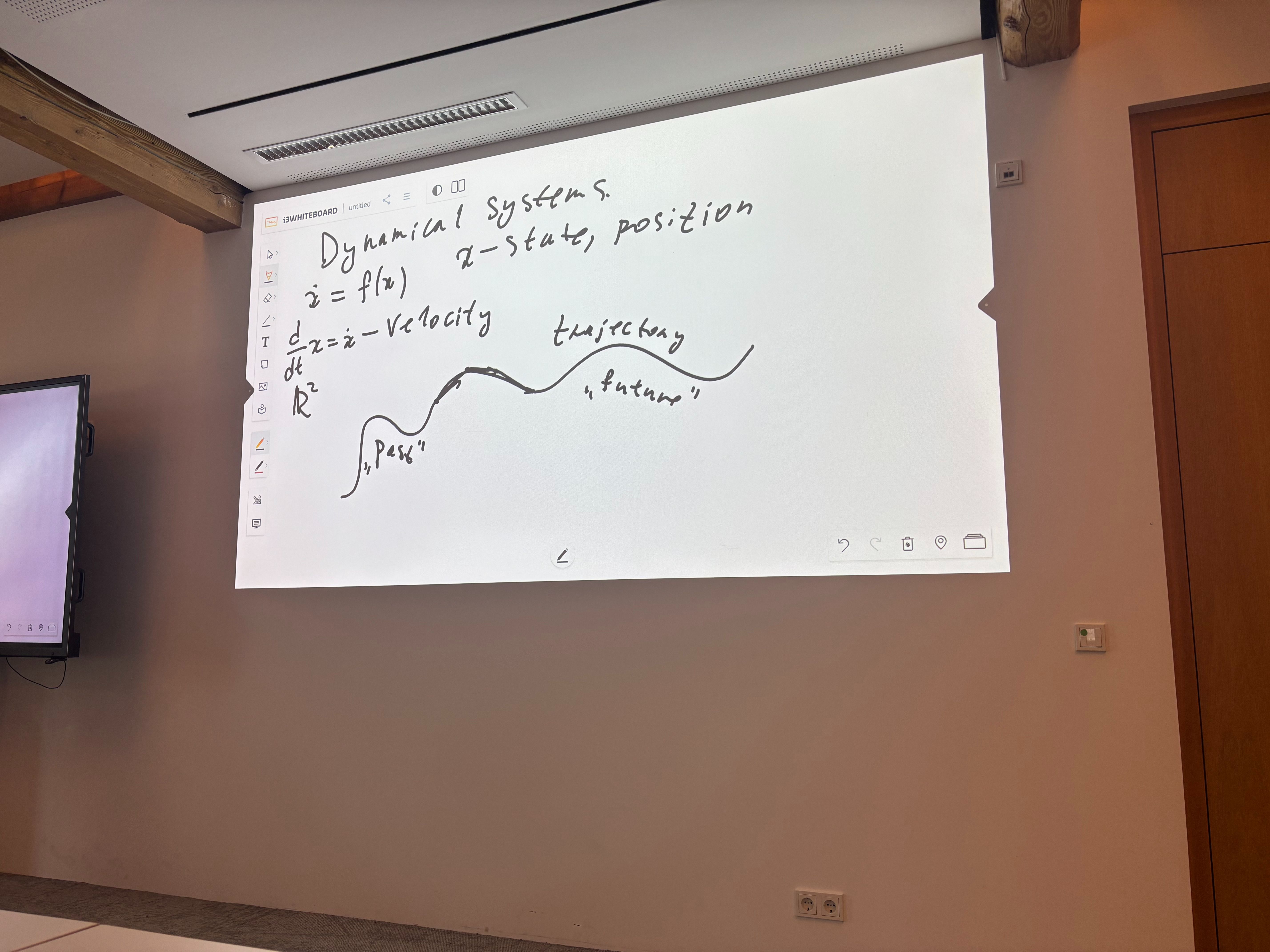
Introduction to Dynamic Systems

Explaining the concept of stability and Instability in physics
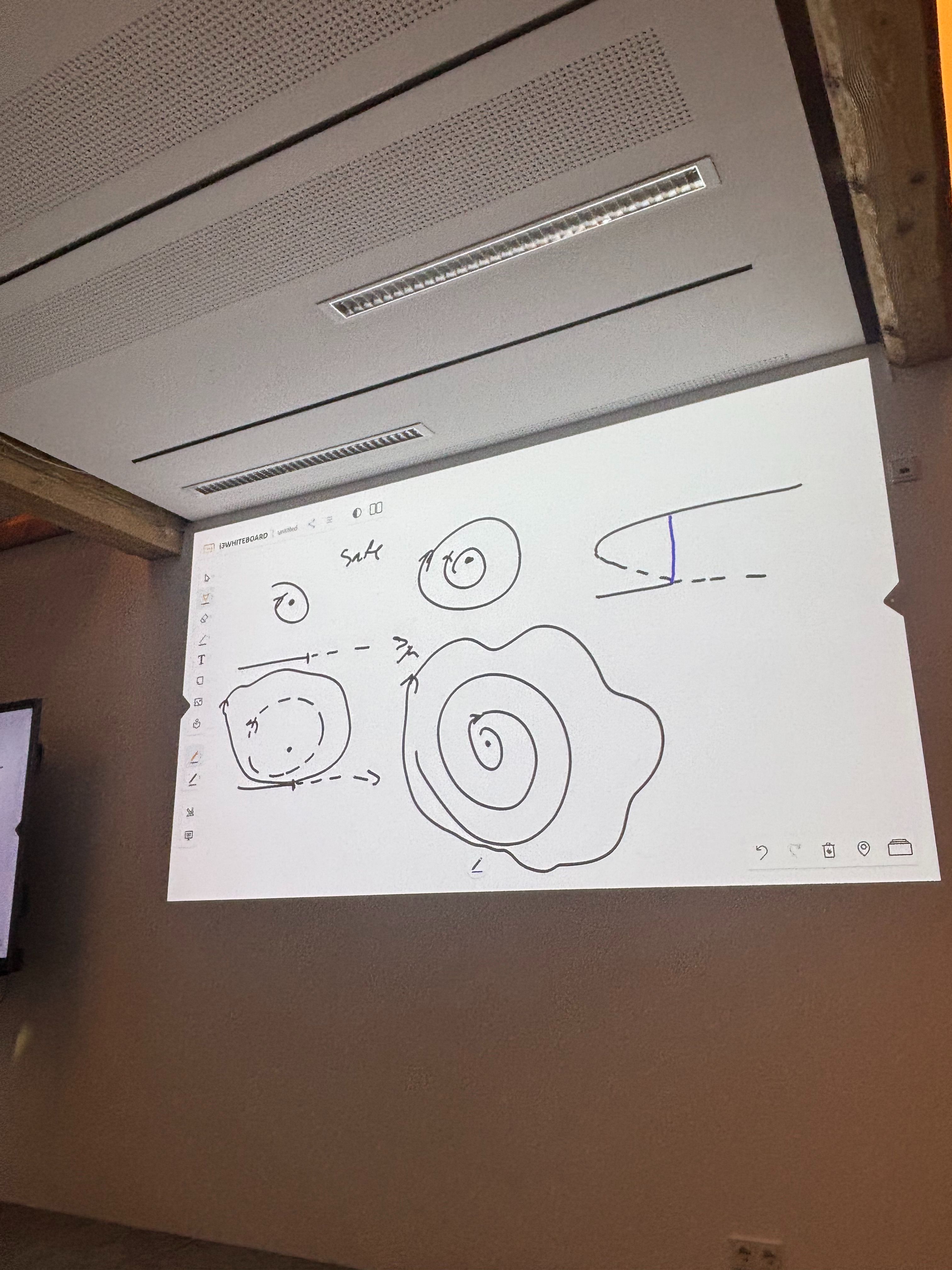
How a stable state can move to an unstable state
The Visual of Chaos: Dr. Ovsyannikov showed us how to "see" stability through phase spirals. He started with a single stable dot—a system at rest. When a system is stable, any "nudge" just causes it to spiral back toward that center point. But as soon as an external parameter (like speed or temperature) changes, that dot flips from a magnet into a "repeller." Instead of settling down, the system begins to spiral out, getting wider and more unpredictable with every turn. This is the exact moment the Butterfly Effect takes over: the further you spiral from that center, the more a tiny mistake changes our entire future path.

Examples of the application of Lorenz Attractors to determine Robust Chaos
Explanation: Dr. Ivan Ovsyannikov took us deeper by explaining that while these systems seem random, they often settle into strange attractors. Think of a ball balanced on a wavy hill; the smallest breeze determines which valley it lands in, but the "shape" of the hill remains the same. By studying robust chaos, we learned that unpredictability isn't just a mess—it’s a mathematical structure. This boundary between order and chaos is exactly where the math gets most interesting, proving that in a non-linear world, no detail is ever truly "insignificant."
We even explored the "spy" side of math! Dr. Ovsyannikov showed us how the Lorenz Attractor can be used for encryption. By using a binary key—like the 110 or 001—to set the starting coordinates of a chaotic system, we can hide messages inside a path of digital noise. To an outsider, the data looks like total randomness, but to anyone with the right mathematical key, it’s a perfectly mapped-out secret. It turns out that the same instability that makes the weather hard to predict is actually the secret to keeping our digital world secure.
The Lorenz Attractor
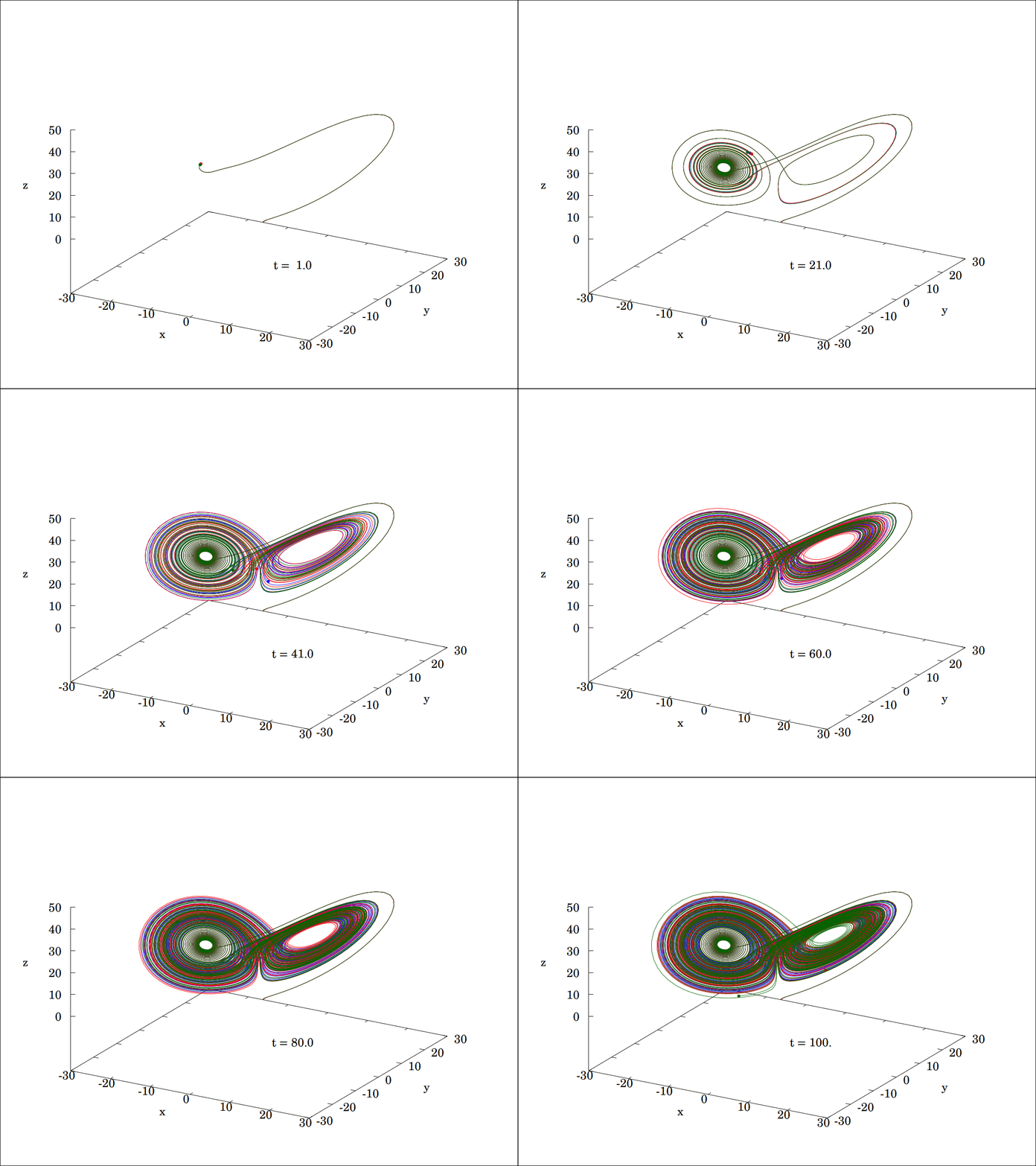
A simple demonstration of the Lorenz Attractor in action
Inside the Lorenz Attractor: This GIF isn't just a pretty shape—it's a map of deterministic chaos. Those swirling lines are trajectories tracking three weather variables (x, y, z) at once.
Watch closely as the lines start together but eventually split apart; this is Sensitive Dependence on Initial Conditions. Even though the math is precise, the tiniest difference with the variable t causes the paths to "diverge" wildly, proving that while the system stays within the beautiful shape of a strange attractor, its long-term future remains forever unpredictable.
Lessons to learn
Small Inputs, Huge Outputs (The Power of "Almost"): Just like a tiny change in a discriminant can flip a parabola from stable to unstable, life doesn't always scale linearly. A five-minute delay or a single "sent" message can be the "nudge" that sends our entire trajectory down a different valley of the wavy hill.
The Limits of Human Prediction: Even if you have the best "sensors" (like a driver focused on the road), complex systems are deterministically unpredictable. Because we can never measure the starting state with infinite precision, long-term forecasting is a mathematical impossibility. We have to learn to plan for the "unplannable.".
Hidden Order within Randomness: Even when things look like total chaos (like a massive traffic jam), they are often following a Strange Attractor. Chaos isn't "messiness"; it’s a complex, bounded pattern. This teaches us that even in the most turbulent times, there is usually an underlying structure or "shape" to the madness.
"Does the flap of a butterfly’s wings in Brazil set off a tornado in Texas?"
— Edward Lorenz, a meteorologist speaking in a conference in 1972
"The things that really change the world, according to Chaos theory, are the tiny things..."
— Neil Gaiman's book (Good Omens)